



Last updated: October 21, 2026. Next scheduled update: January 2027.
This guide is for education only and is not legal advice. Laws change, and the details of your deal matter. Talk to a real estate attorney licensed in your state before you sign or assign a contract.
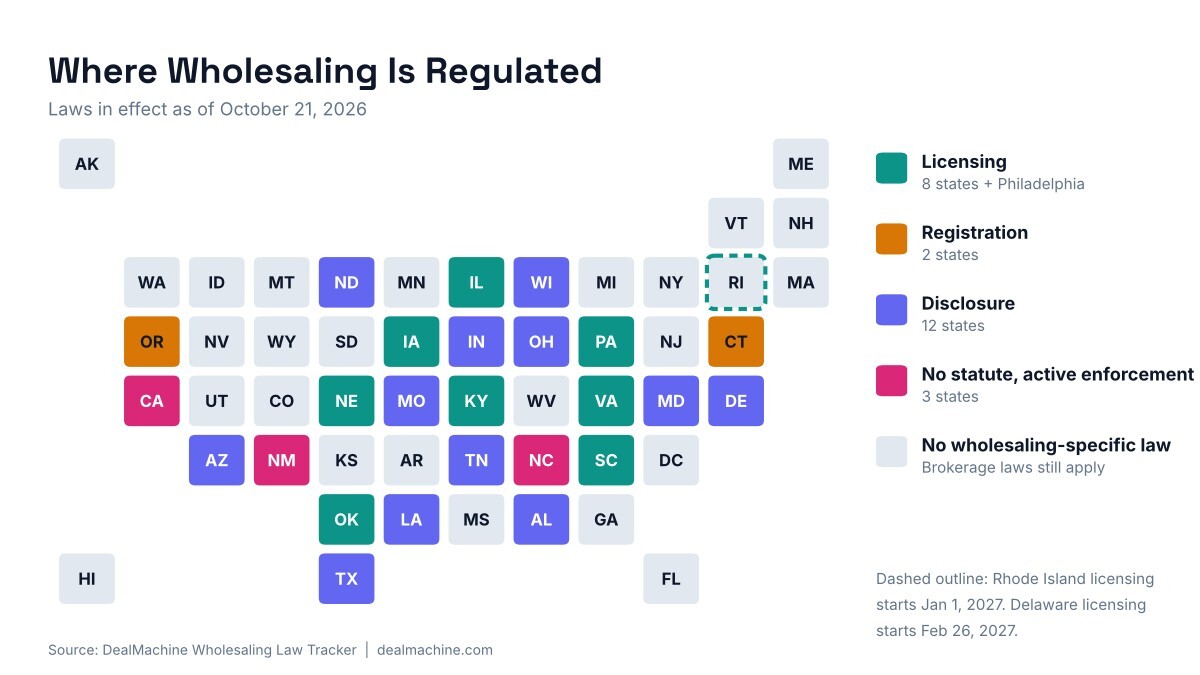
Wholesaling is still legal in all 50 states. No state has banned it outright. But 22 states and the City of Philadelphia now have laws written specifically for wholesalers, and two more licensing deadlines hit in early 2027.
This page tracks the wholesaling laws by state that are actually in effect today, explains what each one requires, and flags what is coming next. Most of the 2026 wholesaling laws took effect in just the last 12 months, so we update this page every quarter from our internal law tracker, which checks bill status and effective dates weekly.
Here is the short version:
- 8 states require a real estate license for some or all wholesaling activity.
- 2 states require wholesalers to register with the state.
- 12 states allow unlicensed wholesaling but require written disclosures, and many give the seller a right to cancel.
- 3 states have no wholesaling statute, but regulators are actively enforcing general brokerage laws against wholesalers.
What This Guide Covers
- The three types of wholesaling rules
- Every state with a wholesaling law in effect
- Licensing states
- Registration states
- Disclosure states
- States with no statute but active enforcement
- Myth check: Michigan's "5-deal rule"
- Outreach laws that affect wholesalers
- Upcoming: laws that take effect soon
- Pending bills to watch
- The bottom line
- What changed this quarter
- Frequently asked questions
The Three Types of Wholesaling Rules
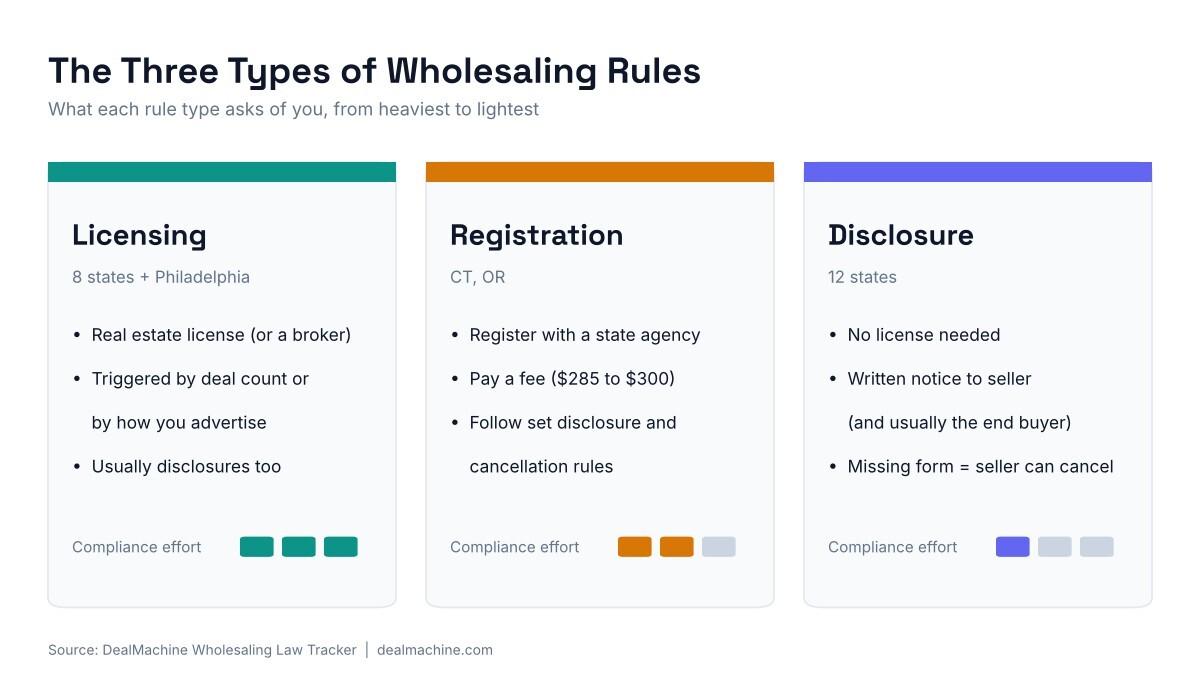
Every law on this page falls into one of three buckets. Once you know your state's bucket, you know roughly how much work compliance takes.
- Licensing: The state treats some or all wholesaling as real estate brokerage, so you need a license or a licensed broker. Some states count your deals. Others look at how you market them.
- Registration: No full license, but you register with a state agency, pay a fee, and follow set deal rules.
- Disclosure: Anyone can wholesale, but you must tell the seller (and usually the end buyer) in writing that you hold an equitable interest and plan to assign the contract for a profit.
Here is the key takeaway. Disclosure laws are the most common type, but they are not "paperwork only." In most disclosure states, a missing form gives the seller a way out of the deal. The disclosure is what protects your assignment fee.
How to Use This Page
- Check the property's state, not yours. If you live in Florida and wholesale in Ohio, Ohio's rules apply.
- Find your bucket in the master table below.
- Count your deals. In Illinois, Virginia, and (starting January 2027) Rhode Island, the second deal in 12 months is the line.
- Use the state's exact disclosure and timing. A generic form may not count.
- Build the seller's cancellation window into your closing timeline before you line up an end buyer.
Every State With a Wholesaling Law in Effect
This table covers every state law that is in effect as of the date at the top of this page. Rhode Island and the Delaware license requirement are not here yet because they have not taken effect. You will find them in the upcoming section.
| State | Rule type | Law | In effect since | Main requirement | Seller cancellation right |
|---|---|---|---|---|---|
| Alabama | Disclosure | SB 228 (Act 2023-201) | Aug 2023 | Written disclosure to seller and assignee; notice of assignment 3 business days before it takes effect | None in statute; treble damages for violations |
| Arizona | Disclosure | HB 2747 (A.R.S. 44-5101) | Sep 2022 | Written disclosure to seller and buyer before a binding agreement | Any time before close of escrow if disclosure is missing |
| Connecticut | Registration | Public Act 25-168 | Jul 2026 | $285 registration, disclosure report, 90-day max to close | 3 business days |
| Delaware | Disclosure (license coming) | SB 201 | Aug 2026 | State disclosure form for every wholesale deal | 21 calendar days |
| Illinois | Licensing | 225 ILCS 454/1-10 | Jan 2019 | License required at 2+ deals in 12 months | None in statute |
| Indiana | Disclosure | HEA 1068 | Jul 2024 | Disclose your role and intent; written contracts with set expiration dates | None in statute |
| Iowa | Licensing | HF 2394 | Jul 2024 | Broker license; disclose all parties' legal identities | If disclosure fails |
| Kentucky | Licensing | HB 62 (2023) | Jun 2023 | License required to advertise an equitable interest | None in statute |
| Louisiana | Disclosure | HB 468 / Act 807 | Aug 2026 | Disclosure, 1% minimum earnest money in escrow, no liens | 5 calendar days |
| Maryland | Disclosure | HB 124 / SB 160 | Oct 2025 | Two-sided disclosure to owner and assignee | If not notified and contract was assigned |
| Missouri | Disclosure | SB 973 | Aug 2026 | Disclosure delivered 14 days before signing | Any time before closing |
| Nebraska | Licensing | LB 892 | Jul 2022 | License to publicly market an equitable interest (vacant lots excepted) | None in statute |
| North Dakota | Disclosure | HB 1125 | Aug 2025 | Written disclosure to all parties; applies to all real property | Before closing if disclosure is missing |
| Ohio | Disclosure | SB 155 | Mar 2026 | Separate, signed, 12-point bold disclosure before contract | Any time before closing if disclosure is missing |
| Oklahoma | Licensing + disclosure | HB 1148 / SB 1075 | Nov 2021 / Nov 2025 | License to market deals; pre-contract disclosure; Oklahoma escrow | 2 business days |
| Oregon | Registration | HB 4058 | Jul 2025 | $300 registration plus background check; 10-point bold disclosure | 3 business days (either side) |
| Pennsylvania | Licensing | Act 52 of 2024 | Jan 2025 | Broker or salesperson license plus disclosure | Later of 30 days or conveyance |
| Philadelphia (city) | Licensing | Phila. Code 9-5202 | Apr 2023 | City wholesaler license on top of state license | Follows state law |
| South Carolina | Licensing | Act 204 (2024) | May 2024 | License to advertise the property; licensees may not wholesale | None in statute |
| Tennessee | Disclosure | SB 909 / Pub. Ch. 72 | Mar 2025 | Disclose equitable interest and intent to assign to seller and buyer | None in statute |
| Texas | Disclosure | SB 1577 | Jan 2024 | Written disclosure to seller and assignee, or it counts as brokerage | None in statute |
| Virginia | Licensing | HB 917 | Jul 2024 | License required at 2+ deals in 12 months | None in statute |
| Wisconsin | Disclosure | 2023 Act 208 | Mar 2024 | Assignment disclosures; applies to licensed and unlicensed wholesalers | None in statute |
Two notes on reading the table. "None in statute" means the wholesaling law itself does not create a cancellation window. Your contract, general consumer protection law, or a court can still give the seller a way out. And "in effect since" is the date the rule started applying, not the date the governor signed it. Those two dates are often months apart, and mixing them up is one of the most common mistakes in wholesaling content.
Licensing States
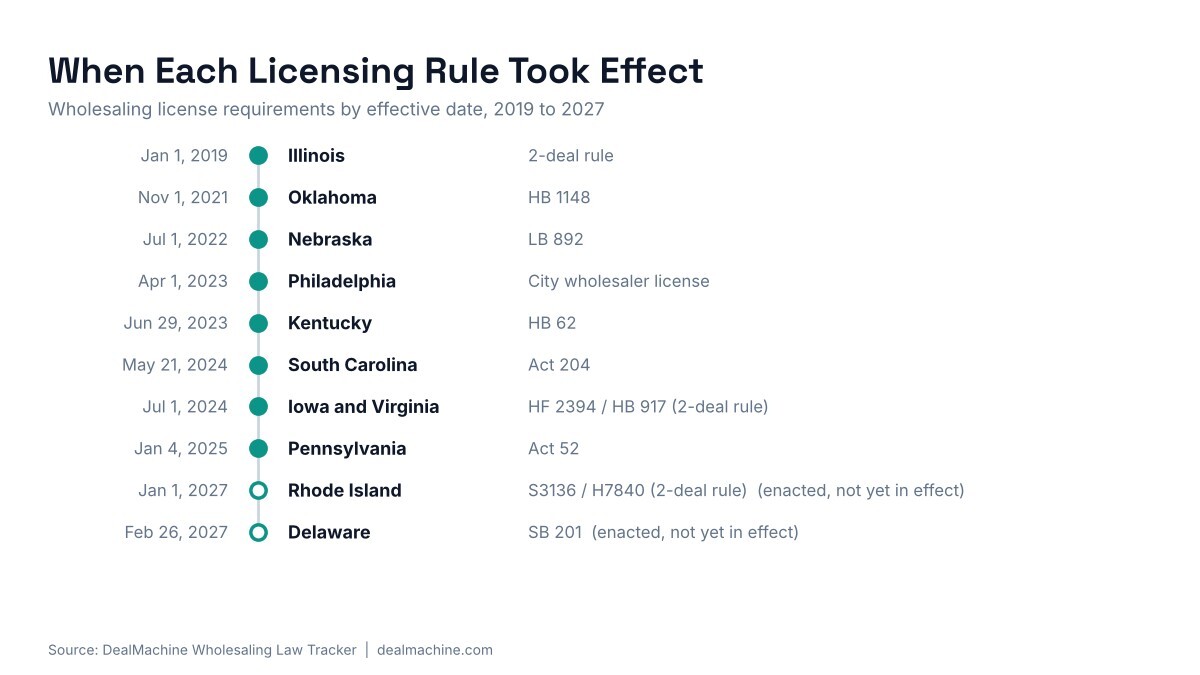
Eight states and the City of Philadelphia require a license for some or all wholesaling. The table covers the basics. Here is what it cannot show.
Illinois and Virginia: The 2-Deal Rule
Two or more assignments in any 12-month period make you a broker under 225 ILCS 454/1-10 in Illinois and HB 917 in Virginia. One deal a year is outside the rule. If your plan is more than that, get licensed or partner with a broker. Our guide to wholesaling real estate in Illinois covers how investors there are adjusting.
Kentucky and Nebraska: The Advertising Trigger
These two states look at marketing, not deal count. Publicly advertising your equitable interest counts as brokerage. Nebraska exempts vacant lots, a detail most coverage leaves out. Kentucky has no such exception.
Iowa
Wholesalers must hold a broker license and disclose every party's legal identity. Penalties reach $10,000 or 10% of the sale price.
Oklahoma: Licensing and Disclosure Together
Oklahoma requires a license to publicly market deals (HB 1148) and, since November 2025, a pre-contract disclosure, a 2-business-day cancellation right, and earnest money held in an Oklahoma escrow account (SB 1075). The part beginners miss: if the disclosures are missing, the contract is unenforceable and the homeowner keeps your earnest money. More in our Oklahoma wholesaling guide.
Pennsylvania and Philadelphia: Two Licenses
Act 52 of 2024 requires a state license, a disclosure that you will assign without taking title, and a seller cancellation right until the later of 30 days or conveyance. Philadelphia adds its own Residential Property Wholesaler License. In the city, you need both. Our Pennsylvania wholesaling guide covers the market side.
South Carolina: Where a License Makes It Harder
Advertising the property requires a license, but advertising your contract position does not. And licensees are prohibited from wholesaling because of the duties they owe clients. South Carolina is the one state where getting licensed closes the door instead of opening it. See our South Carolina wholesaling guide.
When people search for wholesaling license requirements, they want a yes or no. The honest answer depends on your deal count, how you market, and whether you already hold a license.
Registration States
Connecticut and Oregon created a middle path. You do not need a real estate license, but you do need to register with the state and follow a set of deal rules.
| Requirement | Connecticut | Oregon |
|---|---|---|
| Law | Public Act 25-168 | HB 4058 |
| In effect since | July 1, 2026 | July 1, 2025 |
| Agency | Department of Consumer Protection | Oregon Real Estate Agency |
| Fee | $285 | $300 initial, $300 annual renewal |
| Renewal | Every even year, July 31 | Every year |
| Disclosure | Signed wholesale disclosure report before contract | 10-point bold disclosure to buyers, sellers, and assisting brokers |
| Cancellation | 3 business days (seller) | 3 business days (either side) |
| Other rules | 90-day max from contract to closing; no liens; must identify as a registered wholesaler in marketing | Criminal background check; liability for damages plus the other side's attorney fees |
| Licensees exempt? | No. Licensees need a separate registration. | Registration applies to unlicensed wholesalers |
Connecticut: Holding a Connecticut real estate license does not exempt you from registering, and the 90-day cap from contract to closing rules out long marketing periods. Apply through the Department of Consumer Protection, and see our Connecticut wholesaling law guide.
Oregon: Most sources will date this law to 2024, the year it passed, but it actually took effect July 1, 2025. The law applies when you hold an equitable interest or option for under 90 days and put under $10,000 into improvements, which gives you a clear test for your own deals. Details are on the Oregon Real Estate Agency's site.
Disclosure States
Twelve states let you wholesale without a license as long as you disclose. These wholesale disclosure laws are the most common type of rule, and most require a written notice that you hold an equitable interest, intend to assign, and plan to profit. These are the details that change how you run a deal.
- Alabama: Notify the seller of any assignment at least 3 business days before it takes effect. Violations carry three times your fee in damages (Ala. Code 8-42-2).
- Arizona: Skip the disclosure and the seller can cancel any time before close of escrow and keep your earnest money (A.R.S. 44-5101).
- Delaware: Use the state's Disclosure for Wholesale Transaction form. Sellers get 21 calendar days to cancel and a refund within 10 business days. Structuring the deal as a novation or power of attorney does not get around it.
- Indiana: Contracts must be written with definite expiration dates. See our post on Indiana's real estate regulations.
- Louisiana: The only state with a minimum earnest money rule: 1% of the price, held in escrow. On a $150,000 contract, that is $1,500. Sellers get 5 days to rescind. Details in our Louisiana HB 468 breakdown.
- Maryland: Disclose to the owner before the contract and to the end buyer before the assignment. Either side can rescind if you skip it.
- Missouri: The strictest timing in the country. A separate 12-point bold disclosure must be delivered 14 days before the contract is signed. See our Missouri SB 973 guide.
- North Dakota: Applies to all real property, including land and commercial, not just homes.
- Ohio: A separate, signed, 12-point bold disclosure before contract. Without it, the seller can cancel any time before closing. Our Ohio disclosure law guide has the checklist.
- Tennessee: Disclose to both the seller and any later buyer. No cancellation window in the statute.
- Texas: If you fail to disclose in writing, the law treats it as unlicensed brokerage. More on wholesaling in Texas and getting a Texas license.
- Wisconsin: Applies to every wholesaler, licensed or not.
No Statute, But Regulators Are Enforcing Anyway
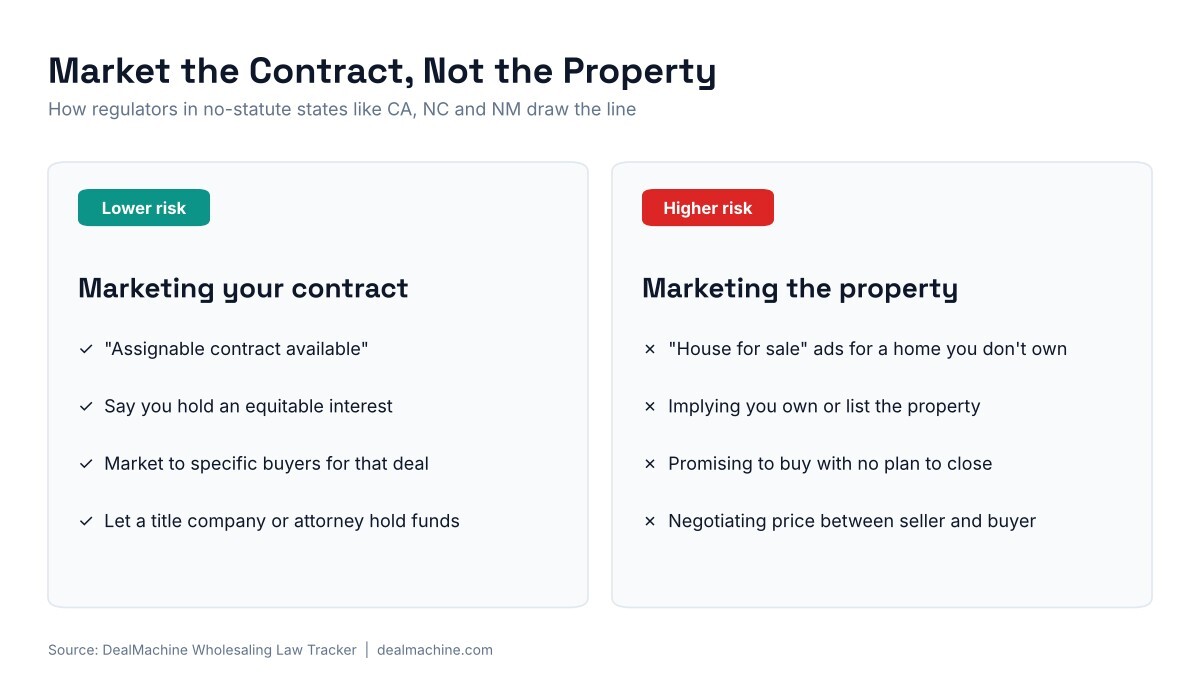
A state without a wholesaling law is not a free zone. Every state bans brokering real estate without a license, and these three have spelled out how that applies to wholesalers.
- California: The Department of Real Estate sends cease and desist letters to wholesalers who market the property instead of their contract. Penalties reach $20,000 and 6 months in jail for individuals and $60,000 for companies. The DRE publishes its enforcement actions monthly.
- North Carolina: The Real Estate Commission treats it as unlicensed brokerage if you promise to buy with no plan to close, handle someone else's earnest money, negotiate between seller and buyer, or market to buyers beyond a specific contract. It is a Class 1 misdemeanor. Read the NCREC bulletin and our North Carolina wholesaling guide.
- New Mexico: It shows up on many "licensing states" lists, but it has no wholesaling statute. The practical limit is that you cannot advertise the property itself without a license.
The pattern is the same in all three: market the contract, not the property.
Myth Check: Michigan's "5-Deal Rule"
You will still find ranking pages that say Michigan lets you do five wholesale deals a year before you need a license. That rule does not exist.
The administrative rule people are citing, R 339.22319, was rescinded on March 29, 2017. There is no deal-count cap anywhere in Michigan's current Occupational Code. Whether you need a license depends on a standard brokerage analysis under MCL 339.2501, the same as any other real estate activity.
Michigan does have a pending wholesaling bill, HB 5366. It is covered in the pending section below.
Outreach Laws That Affect Wholesalers
Wholesaling laws control the contract. Outreach laws control how you reach the seller. This section will grow as states pass new rules on calls, texts, and solicitation.
The TCPA (Federal)
The Telephone Consumer Protection Act of 1991 limits calls and texts sent with an autodialer or prerecorded voice, and it’s the legal basis for the National Do Not Call Registry. Violations cost $500 each, or up to $1,500 if willful, and every call or text counts separately. The law targets telemarketing, which the FCC defines as encouraging someone to buy, rent, or invest in property, goods, or services. Some courts have ruled that calls offering to buy a house fall outside that definition. Others have not, so results depend on the court and the facts. Our TCPA compliance guide covers the case law.
Texas SB 140
Since September 1, 2025, Texas law counts text messages and images as "telephone solicitation," the same as calls. Treat every text to a Texas seller like a call. See our Texas SB 140 explainer.
Upcoming: Laws That Take Effect Soon
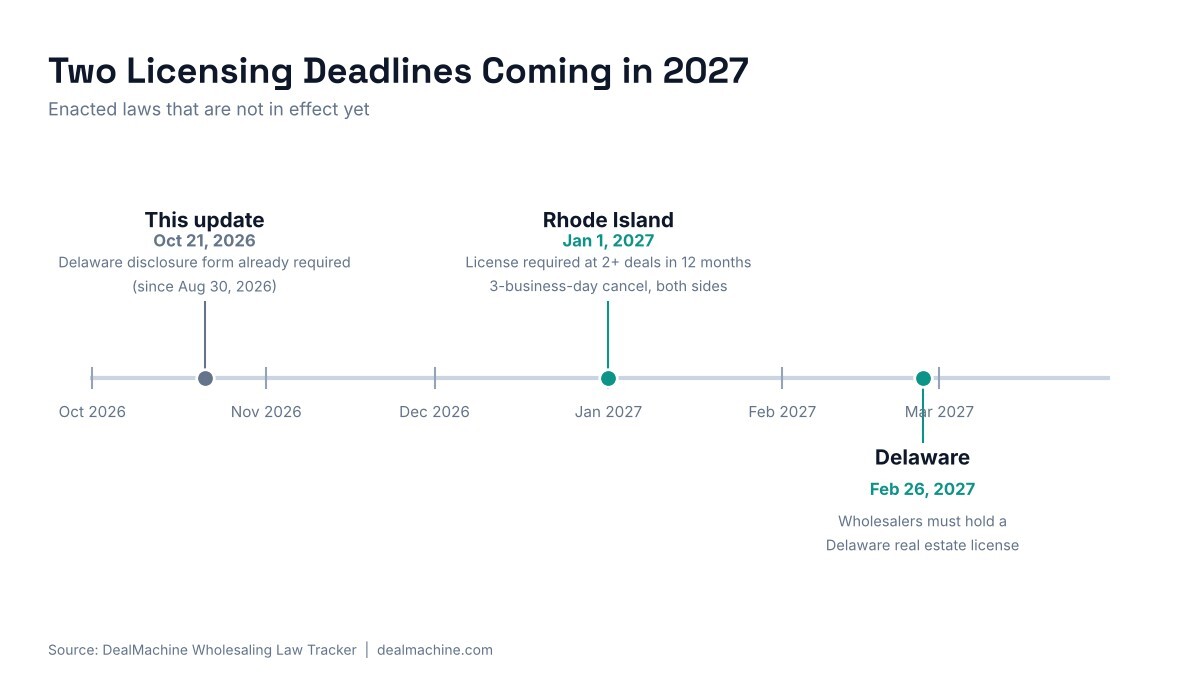
Two states have passed licensing laws that are not in force yet. Both start in early 2027. Watch the effective dates, not the signing dates. Mixing them up is the most common error in coverage of these laws.
Rhode Island: Licensing Starts January 1, 2027
Signed June 23, 2026, effective January 1, 2027. Here is what changes:
- The 2-deal rule: More than one assignment in 12 months makes you a broker, the same as Illinois and Virginia.
- Disclosure on both sides: The seller learns you may assign for a fee. The buyer learns you hold an equitable interest, not title.
- 3-business-day cancellation for both sides: It cannot be waived, and the deal cannot close until it runs out. That slows down fast double closes.
- No forced title company: You cannot stop the end buyer from using their own closing attorney or title insurer.
- Penalties: $500 to $1,000 fines, plus civil liability of at least your fee and up to three times it.
Delaware: Licensing Starts February 26, 2027
SB 201's disclosure rules are already live. The license requirement starts February 26, 2027. One open question: the state's mandatory disclosure form already asks for a Delaware license number and broker contact, months before the law requires a license. As of our last check, no licensing pathway for wholesalers had been published. If you wholesale in Delaware, call the Division of Professional Regulation at 302-744-4500 before your next deal.
Pending Bills to Watch
These bills are not law. They are listed here because they are still alive, or because they show where the next wave of rules is headed.
| State | Bill | What it would do | Status (as of Oct 21, 2026) |
|---|---|---|---|
| New Jersey | A4278 | License requirement for wholesale transactions plus consumer rights | In Assembly Regulated Professions Committee since Feb 19, 2026; no hearing yet. NJ sessions run two years, so it stays alive into 2027. |
| Michigan | HB 5366 | Adds wholesaling to the Occupational Code with mandatory disclosures | In Committee on Government Operations since Dec 16, 2025 |
| Alabama | HB 586 | License through the Alabama Real Estate Commission; disclosures for wholesalers and unsolicited offer senders | Reached third reading in the second chamber on Apr 8, 2026, then carried over. Alabama does not carry bills between sessions, so expect it to be refiled in 2027. |
| Pennsylvania | HB 600 | A second wholesaler license, disclosure 3 days before any offer, and a statewide do-not-solicit list | No committee action. Dies when the session ends Nov 30, 2026. |
Pennsylvania's HB 600 dies this session, but watch for it in 2027. Every law on this page regulates what you tell a seller. HB 600 would have regulated whether you can contact them at all, through a state-run do-not-solicit list. A bill like that would affect list building, direct mail, and door knocking, not just paperwork.
The Bottom Line
This isn't complicated, but you do need a process. Know your state's bucket, use its exact disclosure, respect its cancellation window, and market the contract instead of the property. Start from a state-specific template on our wholesaling contracts page, have an attorney review it, and read our guide to the assignment contract to understand each clause.
Compliance protects your fee, but you still need deals worth protecting. DealMachine helps you find motivated sellers, pull owner contact information, and run outreach from one app. Find the capacity that works for you.
What Changed This Quarter
Q4 2026 (October 21, 2026): First edition. Recent changes captured in this edition:
- Connecticut: Wholesaler registration opened July 1, 2026.
- Louisiana: HB 468 took effect August 1, 2026, including the 1% earnest money floor.
- Missouri: SB 973 took effect August 28, 2026.
- Delaware: SB 201 disclosure rules and the state form took effect August 30, 2026. Licensing follows on February 26, 2027.
- Rhode Island: Licensing law signed June 23, 2026, effective January 1, 2027.
- Pennsylvania: HB 600 will die with the session on November 30, 2026.
Frequently Asked Questions
Is wholesaling legal in all 50 states?
Yes. As of October 2026, no state bans wholesaling outright. But 22 states and Philadelphia regulate it with a license, a registration, or required disclosures. In states without a wholesaling law, general real estate licensing laws still apply, especially if you advertise a property you do not own.
Which states require a license to wholesale real estate?
Illinois, Iowa, Kentucky, Nebraska, Oklahoma, Pennsylvania, South Carolina, and Virginia have license requirements in effect, and Philadelphia has its own city license. The trigger varies. Illinois and Virginia count deals, Kentucky and Nebraska look at advertising, and South Carolina bars licensees from wholesaling. Rhode Island joins the list on January 1, 2027, and Delaware on February 26, 2027.
How many wholesale deals can you do before you need a license?
In Illinois and Virginia, one per 12 months. The second deal makes you a broker. Rhode Island uses the same rule starting January 1, 2027. Most other states do not use a deal count at all. They look at how you market and what you disclose. The often-quoted Michigan "5-deal rule" was rescinded in 2017.
Can a seller cancel a wholesale contract?
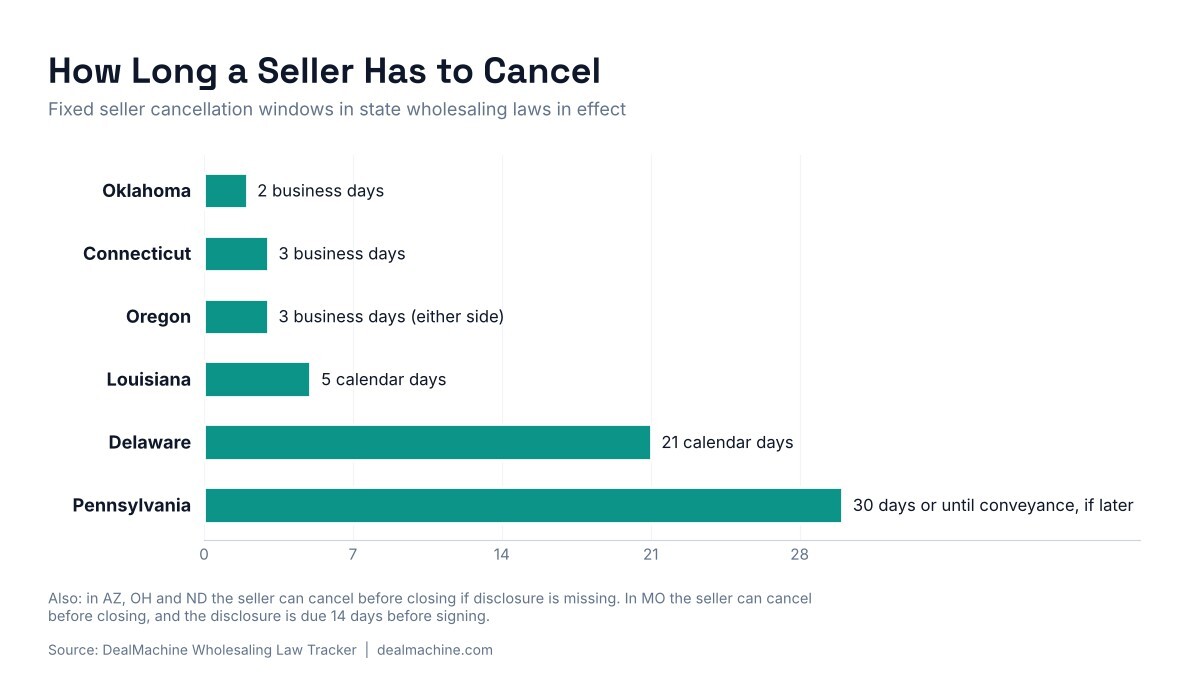
In many states, yes. Fixed cancellation windows range from 2 business days in Oklahoma to 30 days in Pennsylvania. In Arizona, Ohio, Missouri, and North Dakota, the seller can cancel any time before closing if your disclosure was missing or late. Always check the state's rules before you lock in an end buyer's closing date.
Important Disclaimer: This guide is for general educational and informational purposes only. It is not legal advice, does not create an attorney-client relationship, and is not a substitute for advice from a licensed real estate attorney in the state where the property is located. Wholesaling and related real estate laws vary by state and locality, change frequently (including effective dates, regulatory interpretations, and pending bills), and depend on the specific facts of each transaction (e.g., number of deals, marketing methods, property type, contract structure). DealMachine does not warrant the accuracy, completeness, or currency of any information on this page. The “as of” date reflects our internal tracker at the time of publication; laws and bill status can change after that date. Any reliance on this content is at your own risk. Always consult a qualified attorney licensed in the relevant jurisdiction before signing, assigning, marketing, or closing any contract, and confirm current requirements with the applicable state agency.
The information in this post is current as of: October 21, 2026.